Your Brain Is Lying to You: The Hidden Mental Traps That Make Casino Games Feel Beatable

Here's something most players never stop to consider: the feeling that you're about to win is not the same thing as actually being close to winning. Yet that feeling — warm, electric, almost convincing — is one of the most powerful forces in casino gaming. It keeps players at the table longer, encourages bigger bets, and turns a casual session into something that quietly empties a bankroll.
The math behind casino games is straightforward. The psychology is anything but.
If you've ever walked away from a session thinking you were unlucky rather than outplayed by probability, you're not alone. Almost every player does it. The question is whether you're willing to look honestly at why.
The Illusion of Control Is Very, Very Real
Psychologists have a name for it: the illusion of control. It's the belief — usually unconscious — that your choices, rituals, or timing influence outcomes that are actually determined by random number generators or fixed odds.
You see it constantly at the slots. Players who tap the spin button a specific way. Players who switch machines after a cold streak, convinced the next one is "due." Players who believe their lucky hoodie is doing something statistically meaningful.
None of it matters. But that's not the point. The point is that feeling in control makes the experience more engaging. Casino game designers understand this deeply. That's why slot machines let you choose your bet size, select paylines, and hit a physical button rather than just watching the reels spin automatically. The mechanics of choice are baked in — not because your choices change the outcome, but because they make you feel invested.
Table games amplify this further. In blackjack, you do make real decisions that affect outcomes. But most players overestimate how much skill they're exercising, especially in the early stages of learning the game. The house edge in blackjack hovers around 0.5% with perfect basic strategy — but the average recreational player is operating with a much higher effective edge against them because their decision-making is imperfect. The gap between feeling competent and being competent is wider than most people realize.
Confirmation Bias: You Remember the Wins Differently
Ask any regular casino player to describe their history at the tables, and you'll notice a pattern. The big wins come with full detail — the exact bet, the moment, maybe even what they were wearing. The losses blur together into vague "bad nights" or "rough stretches."
That's confirmation bias at work. The human brain naturally prioritizes information that supports what it already wants to believe. If you want to believe you're a winning player, your memory will cooperate. It will archive your wins in high definition and store your losses in a much lower resolution.
This isn't a character flaw. It's just how human memory works. But it creates a genuinely dangerous distortion when applied to gambling. Players who have lost more than they've won over their lifetime will often sincerely believe the opposite — not because they're lying, but because their brain has curated a highlight reel.
The fix is simple in theory and hard in practice: keep records. Write down every session, every win, every loss. Numbers don't have feelings. They don't remember selectively. A spreadsheet will tell you a more honest story about your casino history than your memory ever will.
Near-Misses Aren't Almost-Wins — They're Engineered Moments
Of all the psychological mechanics in casino gaming, the near-miss might be the most potent. You spin the slots and two jackpot symbols land. The third stops one position off. Your pulse quickens. You feel like you almost had it.
Here's what's actually happening: that moment was designed. Slot machine algorithms can be configured to produce near-miss outcomes more frequently than pure randomness would generate them. Regulatory frameworks in the US vary on how tightly this is controlled, but the underlying psychology is the same regardless — near-misses trigger the same dopamine response as actual wins. Your brain doesn't cleanly distinguish between "I won" and "I almost won." Both feel significant. Both push you toward another spin.
Research in behavioral psychology consistently shows that near-misses increase the motivation to continue playing, even when players intellectually understand that each spin is independent. Knowing this doesn't fully neutralize the effect — but it does give you a frame to recognize what's happening in real time.
When you feel that near-miss pull, try naming it out loud (or in your head): "That was an engineered moment, not a signal." It sounds almost too simple, but interrupting the automatic response with conscious thought is genuinely effective.
The Gambler's Fallacy Still Fools Smart People
You don't have to be unsophisticated to fall for the gambler's fallacy. It catches educated, analytically minded players all the time.
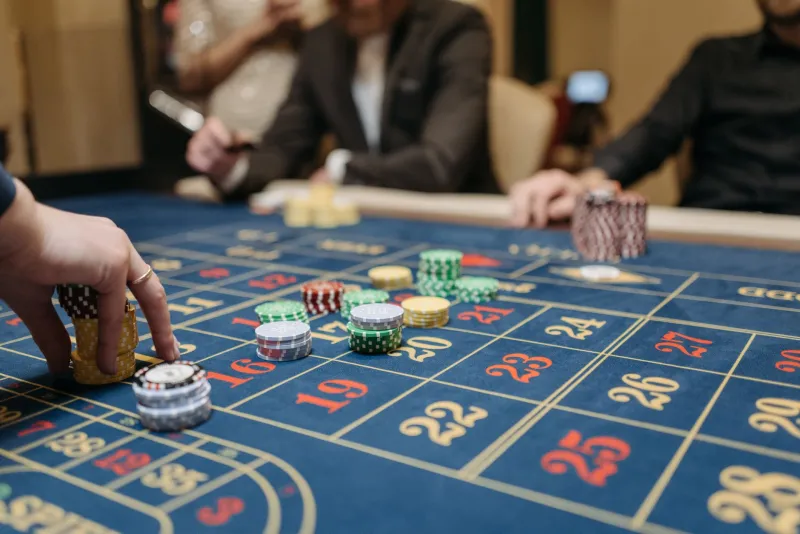
The fallacy is the belief that past outcomes influence future ones in games of independent chance. Roulette lands on black seven times in a row, and the pressure to bet red feels almost logical — surely it has to come up soon. But the roulette wheel has no memory. The probability of red on the next spin is the same as it was on spin one: roughly 47.4% on an American double-zero wheel.
The house edge on American roulette sits at about 5.26%. That number doesn't flex based on recent results. It doesn't care about your streak. It just grinds, slowly and consistently, in one direction.
The same principle applies to slots. A machine that hasn't paid out in hours isn't "due." A machine that just paid a jackpot isn't "cold." Each spin is its own isolated event. The math resets every single time.
Keeping Realistic Expectations Without Killing the Fun
None of this is an argument against playing. Casino gaming is entertainment, and entertainment has a cost. The question is whether you're paying that cost with clear eyes or through a fog of cognitive distortion.
A few practical anchors worth keeping:
Set a loss limit before you start, not during. In-session decision-making is heavily influenced by the biases we've covered. Decisions made before you sit down are cleaner.
Treat wins as variance, not validation. A good session doesn't mean you've figured something out. It means probability moved in your favor temporarily.
Know the actual house edge on the games you play. Baccarat banker bet: 1.06%. American roulette: 5.26%. Keno: sometimes 25-30%. These numbers matter. They're the honest version of your odds.
Pause after near-misses. Even a ten-second pause before your next bet gives your prefrontal cortex time to catch up with your limbic system.
The house edge is real, consistent, and indifferent to how you feel about it. The games are still fun. The entertainment is still worth something. But the first step to playing smarter is accepting that your brain is actively working against your ability to see the odds clearly — and deciding to look anyway.